
Meet the researcher – Yukun Lai
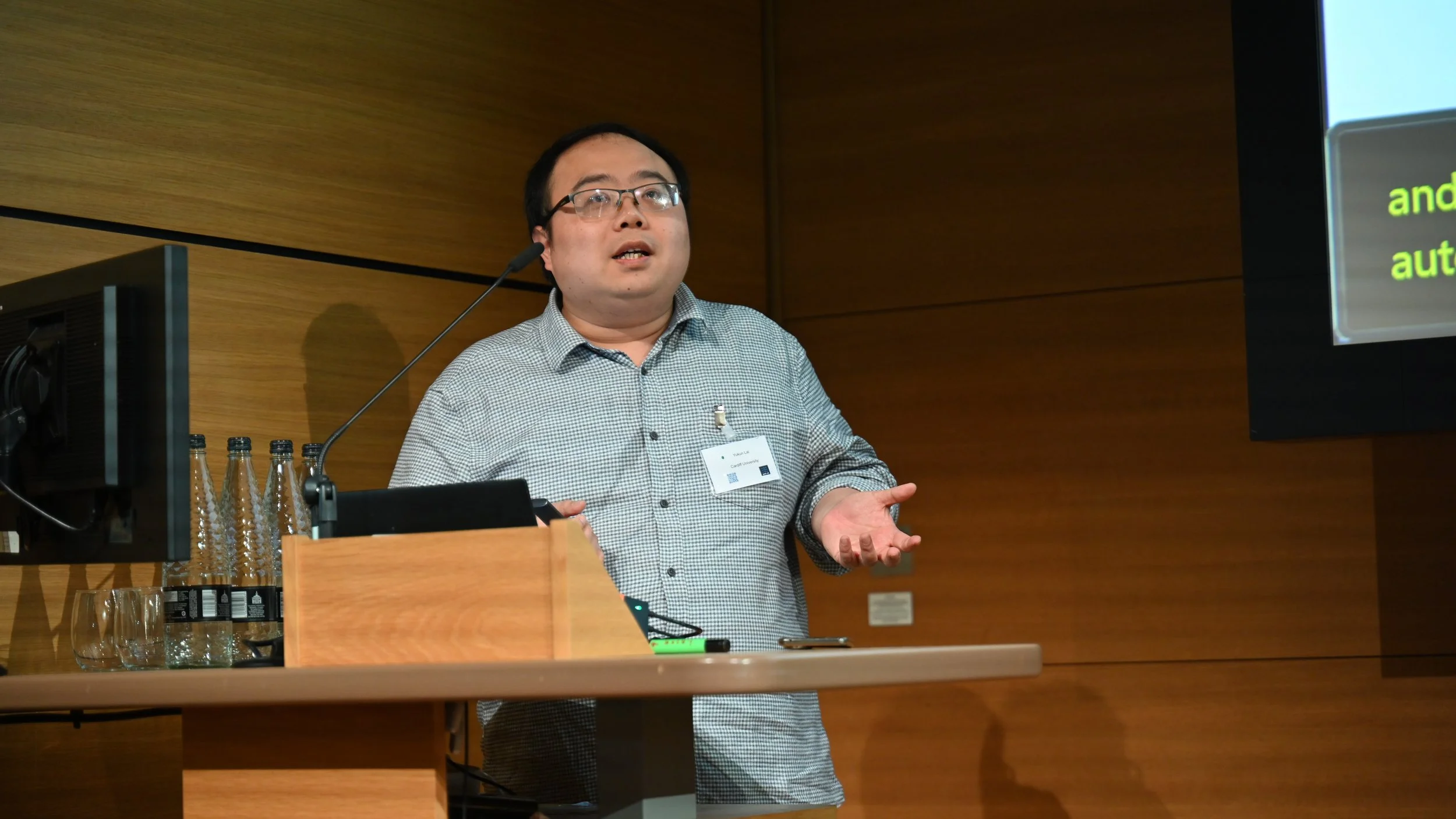
Yukun Lai,
Cardiff University
“We can see the great potential for using AI technology to allow studies to move out of the labs.”
Cardiff University’s Yukun Lai has found his niche where the worlds of computer graphics and computer vision research meet, allowing him to explore his passion for solving real-world problems.
Tell me about yourself and your work?
I’m working in the joint areas of computer graphics and computer vision. In simple terms, I am interested in how we can take things like images, videos and 3D shapes, and turn them into meaningful representations that computers can analyse, understand, manipulate or generate.
Being a researcher is a privilege because it allows me to work closely with PhD students, as well as local and international researchers. I really enjoy the feeling of solving practical problems. Understanding and reconstructing 3D shape enables real-world 3D environments to be represented digitally, with semantic understanding. Similarly, generative models allow images and 3D content to be created much more easily.
My computer graphics mindset means I don’t just like fully automatic solutions - I also value techniques such as simple sketch‑based interfaces that users can easily control. These approaches have applications ranging from creative design to virtual reality.
Give me some examples of these practical problems?
To solve real-world problems, I work with researchers in different disciplines and sectors. For example, I work with the university’s School of Psychology to develop techniques to analyse automated head-mounted video camera footage to understand how young children with motor difficulties experience visuals differently. We can see the great potential for using AI technology to allow studies to move out of the labs, using automated analysis of egocentric footage to understand how young children interact with natural environments, while substantially reducing the needs for manual annotation.
In the past couple of years, I was involved in two Innovate UK-funded projects, working with creative industry companies. These projects adapted and developed AI techniques for producing textures to augment 3D printed objects and speeded-up simulations for the development of realistic games.
Which of the hub’s working groups are you part of?
Although I am interested in several Gen AI related topics, such as responsible AI, methodology and automation, my work is most closely related to two working groups: Multimodal Models and Creative AI. I am a co-lead for the multimodal models working group. While most people’s understanding of AI is systems that work with text, our members’ expertise covers images, videos, 3D data, audio, and more specialised modalities such as human motion, medical images, sketches.
What are your hopes for the working group and the hub more generally?
I hope the working groups and the hub in general can help bring together like-minded researchers with common or complementary interests, for example, images versus audio, visual data versus text data. I am also keen to learn insights and methodologies from more theoretical researchers, which could help advance the research areas I’m working on. As Generative AI is becoming increasingly popular for practical applications, I am also keen to build up connections - for example, in medical applications, where multimodal generative AI can be useful. Although PhD students are not officially part of the AI hub, given its size and scale and the involvement of PhD students in carrying out relevant, original research, the hub provides great opportunities for them to extend their networks, join workshops, and collaborate with leading researchers from other universities.
What do you think the AI Hubs bring to the research ecosystem?
Generative AI is one of the major areas where we have seen recent breakthroughs in AI research and applications. I think the AI hubs can shape the research ecosystem by bringing together academics and industrial practitioners, naturally encouraging interdisciplinary collaboration, and providing a centralised contact point for the communities who need specialised knowledge and expertise related to generative AI. Although, unlike Centres for Doctoral Training, AI hubs are not primarily built for research training, postdoctoral researchers and PhD students can still develop their research while working to achieve the hub’s research goals, so essentially, AI hubs also contribute to the training of next-generation researchers.
So how did you end up as an AI researcher?
Coincidence, maybe. I have always been interested in developing algorithms to use computers to solve practical problems. I won a gold medal in the National Olympiad in Informatics in China when I was still in high school. After my undergraduate studies, I chose to work on 3D geometry and later also on images. I felt these topics were less structured, often related to semantics and human perception, and thus more challenging, compared with general data processing. The research was originally not considered as ‘AI’. While I haven’t really changed my direction, AI and AI-related techniques have developed so much that I was one of the earliest researchers to use AI techniques including generative models to solve 3D geometry processing tasks.
What would it surprise people to know about you?
I enjoy cooking and prepare most of the family meals at home. They’re mostly Chinese-style dishes, often adapted using locally available ingredients, but I also regularly make roast dinners, curries, and pasta.
