
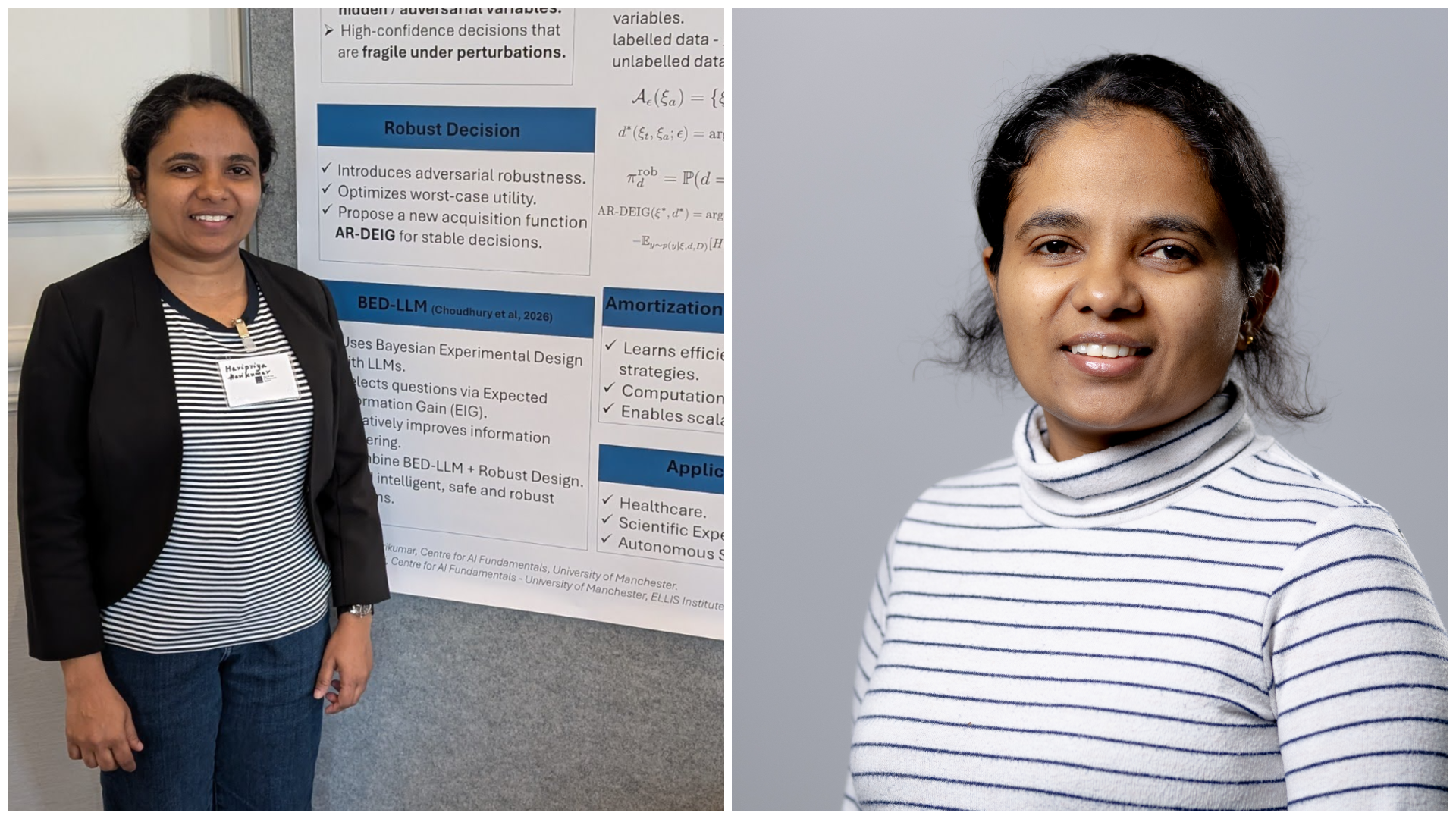
Working at the intersection of AI and science, Haripriya Harikumar develops methods to tackle uncertainty in generative AI applications. She reflects on the rewards of collaborating across disciplines and reveals the historical figure she would most like to question.
Tell me about yourself and your work?
I completed my PhD in Australia with a team of enthusiastic minds, where I studied human behavioural patterns using social media data and machine learning methods to understand the triggers behind addictive behaviours.
What are the hot issues in your specialist area right now?
One of the most pressing questions is how to know when we can trust generative AI. As these systems become more widely used as a tool, an assistant, or a substitute, we need better ways to protect sensitive data, detect hallucinations and recognise situations in which a model’s predictions may be unreliable or risky. Understanding the limits of these systems and how to respond when they reach those limits, is a central challenge in AI safety and security.
“I was fascinated by the idea that algorithms could identify patterns in data and use them to make predictions. At the time, it felt like magic.”
So how did you end up as an AI researcher?
My interest in machine learning began during my master’s degree in Computer Science and Engineering, when one of my professors introduced me to the subject. I was fascinated by the idea that algorithms could identify patterns in data and use them to make predictions. At the time, it felt like magic.
Andrew Ng’s Coursera course gave me a starting point and books by Kevin Murphy and others helped to deepen my understanding. These helped me see a future for myself in AI research.
Describe a project, professional or personal, that you are genuinely proud of and why
I am particularly proud of my current research work with Professor Sami Kaski. Our first publication from this work, which was presented at the UAI 2026 conference, is a small but important milestone. In this work, we proposed an approach for robust decision-making for downstream tasks under adversarial conditions. What excites me is the potential for this research to help address difficult or unpredictable situations in real-world applications across scientific domains.
If you could have dinner with anyone, living, historical, or fictional, who would it be and what would you want to talk about?
There are many, from history to science, and it is hard to pick just one. If I had to choose, it would be Leonardo Da Vinci. As an icebreaker, I would ask him how he wrote such a convincing letter for his job application to the ruler of Milan.
I would also ask about his thought process as a polymath, particularly how he connected ideas across different fields and what advice he would give researchers hoping to do the same today.
PS - I would need help from Google Translate because of the language barrier.
