
Meet the Researcher – Canhui Lui
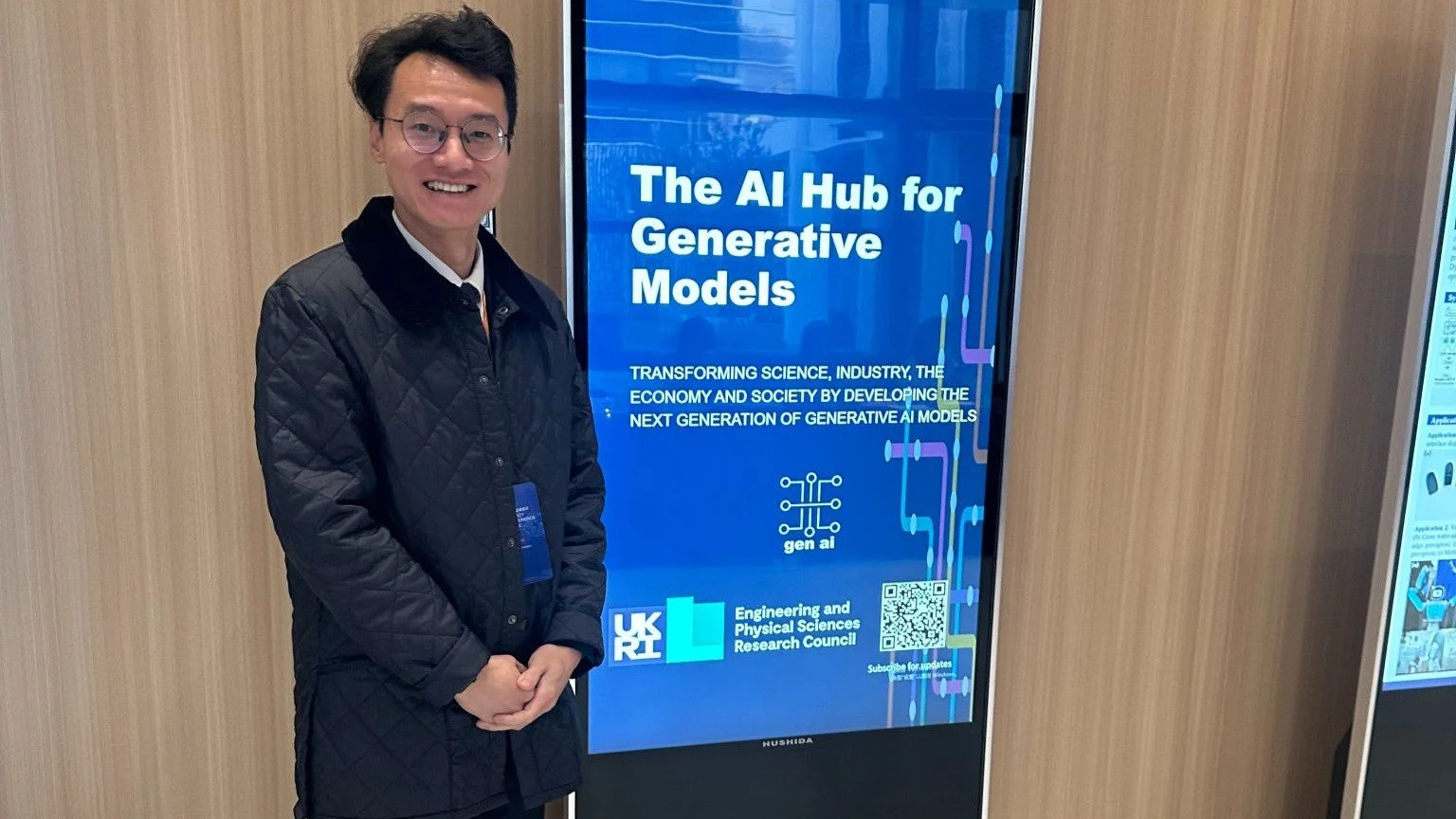
Canhui Lui,
UCL
“Technical excellence does not automatically produce the literacy needed to develop AI responsibly.”
Canhui Lui sees himself as “an untraditional AI researcher” coming via an unlikely route: sociology and policy. That background now fuels his mission to help build “a more society-oriented AI”.
Tell me about yourself and your work
My work sits between policy, social science and responsible AI. I’m interested in how AI develops, how it is governed and how it reshapes society.
A central idea is that AI is not shaped by technology alone. It is also shaped by social structures, institutions, politics, public values and history. These forces are often overlooked, but they strongly affect what kinds of AI are built and what risks emerge.
We often worry about catastrophic risks from Artificial General Intelligence or superintelligence. But many of the more immediate risks come from people and societies using AI in harmful ways. As AI becomes more political and military, it may deepen a new ‘great divergence’ in the world. Before AI takes over humanity, humans may use AI against one another. That is why I don’t see AI as only a laboratory problem. We need social and political discussion at the centre of AI research.
I do not think AI belongs only to computer science. My background gives me a way to think about interaction, communication, trust, norms and cooperation, all of which are becoming central to the future of AI.
What are the hot issues in your specialist area right now?
One of the biggest issues is how we bring public values into AI research. AI is often driven by technical values such as accuracy, efficiency, scale and speed. These are important, but they are not enough. AI now affects education, work, public services, healthcare, democracy and security. So, we also need to ask: whose values are built into AI systems? Who benefits? Who is excluded? And what kind of future are we creating?
Another hot issue is agentic AI. Systems are beginning to plan, act, delegate, and interact with each other, raising difficult questions about responsibility and control. If an AI agent makes a harmful decision, who is responsible?
I am also interested in the social foundations of foundation models. These models are trained on human language, culture, knowledge and labour, so they are not merely technical - they are also social. Understanding their bias, limits, and future potential requires social science, policy, ethics, education and public engagement.
You are leading a collaborative project for the Hub. Tell me more about that
The Responsible AI Literacy Framework project starts from a simple argument: responsible AI literacy is not a soft add-on. It is one of the foundations of AI safety and governance.
People often assume AI literacy is mainly for the public. But it matters just as much for developers, engineers and researchers. Technical excellence does not automatically produce the literacy needed to develop AI responsibly. Someone may understand models, code, data pipelines and benchmarks, yet still lack a deeper understanding of social harm, power, misuse or long-term consequences. Many serious technological risks are not created by ordinary users, but by expert systems making decisions at scale.
AI literacy should become a core competence for the next generation. Students and professionals will need to know not only how to use AI, but how to work with it responsibly: when to trust it, when to challenge it and how to keep human judgement at the centre.
What do you think the AI hubs bring to the research ecosystem?
AI cannot be understood through one discipline alone. The hubs bring together people who might not otherwise work together: computer scientists, social scientists, engineers, policy researchers, industry partners and public stakeholders.
That mixture is powerful. It allows us to ask not only “Can this technology work?”, but also “Should it be built?”, “Who is it for?”, “How should it be governed?”, and “What kind of society does it support?”
They also help bridge the gap between research and real-world impact. AI is moving quickly, but universities have a responsibility to slow it down in the right way: to think carefully, to ask difficult questions and to create evidence that can support better decisions.
For me, the hubs are not just research centres. They are spaces for building a more responsible AI ecosystem.
So how did you end up as an AI researcher?
I position myself as a society-inspired AI researcher. I came to this field through sociology and policy research - an unusual route.
I became interested in AI when I realised it is not just a STEM question; it is a question about society. AI is changing how people work, learn, communicate, govern, create and make decisions. These are classic social science concerns.
“My aim is to help build a more society-oriented AI that is not just more powerful, but more responsible, inclusive and useful for the future we actually want.”
I see myself as an untraditional AI researcher, interested in contributing not only by criticising problems after they appear, but by shaping how systems are designed, evaluated and governed from the start.
Sociology gives us powerful ways to think about interaction, cooperation, trust, institutions, inequality and collective behaviour. These ideas are becoming central to the next stage of AI, especially as humans collaborate with intelligent systems and those systems collaborate with one another.
My aim is to help build a more society-oriented AI that is not just more powerful, but more responsible, inclusive and useful for the future we actually want.
Describe a project, professional or personal, that you are genuinely proud of and why
There are two. The first focuses on the emergence of trust among AI agents. As AI becomes more agentic, systems will increasingly interact and cooperate with other agents. That means trust may become one of the foundations of collective AI. In this project, I use reinforcement learning to study how trust and cooperation emerge among agents in simulated environments: how they learn to coordinate, adapt, share information and build stable cooperation over time.
I am proud of this because it brings sociology into the heart of AI research. Trust is a classic social science question, but it is also becoming a technical problem.
The second is my work on the metascience of AI safety, in collaboration with Jack Stilgoe. This work can support better policymaking for AI safety by showing that safety is not only technical. It is also social and political.
If you could have dinner with anyone, living, historical, or fictional, who would it be and what would you want to talk about?
I’d choose two guests: Norbert Wiener, the founder of cybernetics, and C. Wright Mills, the sociologist who wrote The Sociological Imagination.
Wiener would bring the history of machines, feedback, control and automation. Mills would bring the question of power, public issues and human experience. I’d love to ask them what they make of AI today.
I imagine Wiener would be fascinated, but also worried. He warned early on that automation could create serious social consequences if technical systems were developed without responsibility.
Mills, I think, would ask us to connect private troubles with public issues. When a student worries that AI makes their work meaningless, or a worker fears replacement, those are not just personal anxieties. They are signs of a deeper social transformation.
I would ask them this question: if machines are now learning from society, how do we make sure they learn from the best of us, not the worst?
